
❦ TEXTCAST · No. 004 · Enterprise AI
“Enterprise AI is ten percent model and ninety percent architecture. We bet the firm on the ninety percent.”

By Santthosh Saai Reddy Purmani
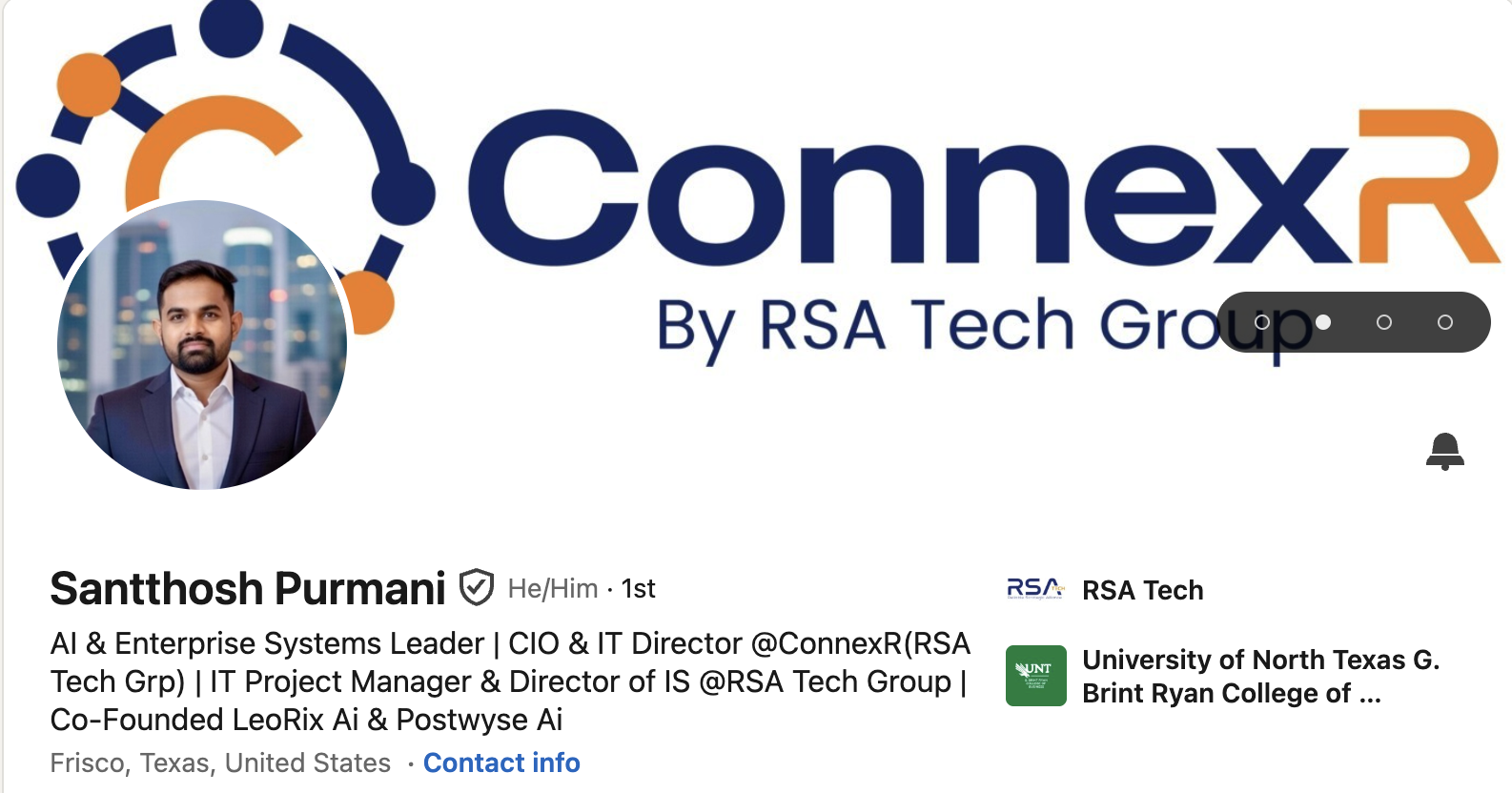
❦ The founder, at a glance
- Growth · 60–70% YoY revenue
- 150+
- IT Managing Director (2026)
- Since 2023 · firm founded 2013
- Little Elm, TX
- Connexr · LeoRix AI
❦ Part · From rescued programs to a practice
On owning both halves — IT and AI — and refusing to ship what won't survive the audit
What made you start what you're building?
Most enterprise AI programs die at the same place. The CIO sees a brilliant prototype, the board sees a press release, and six months later the system is running shadow processes no one trusts, the regulators are asking questions the team cannot answer, and the executive who championed the project is updating their LinkedIn. I came to RSA Tech in 2023 to fix that pattern. The bet was simple: AI does not run in a vacuum. It runs on top of an IT estate that has to hold up under it. So we built a practice that owns both halves, IT and AI managed services as one stack, and we ship production systems that survive the audit, the regulator, the CFO review, and the next quarter. That is the only kind of work that actually counts in regulated industries, and almost no one was doing it well at the time.
What was the moment you knew it was worth doing seriously?
The moment was when the third client in a row called us in to rescue a program their incumbent had said was infeasible. Same pattern every time: a Fortune 500 partner had told them “you cannot get model risk management to sign off on this,” and we got it signed off in sixty days. After the third rescue, I stopped thinking of us as a services firm. I started thinking of us as the team that owns the seam between IT operations, AI, and regulated production, and I bet the practice's roadmap on it.
❦ Part · The build
A cross-cloud stack, on purpose — because the clients are
What's your current stack and why?
We are deliberately cross-cloud because our enterprise clients are. We standardize on Vertex AI and BigQuery for retail and consumer data and AI work, on Azure with a Helix-based Sitecore stack for enterprise digital experience consolidation, and on AWS for financial services and insurance workloads. The agentic AI layer runs on Anthropic Claude, OpenAI, and open-weight models depending on the regulatory profile of the workload. On the IT operations side we run Datadog, PagerDuty, ServiceNow, and Terraform across client estates with Grafana for observability and our own AI-automated project management workflow as the orchestration layer. The non-obvious choice is that we run our own internal delivery operations on the same workflow we ship to clients. We eat what we cook. If the workflow cannot track our own engagements with auditable status, dependency tracking, and budget telemetry, it has no business being in a client's environment.
The stack, in one place
What it takes to run IT and AI as one auditable stack:
- 01Cloud — AWS, Azure, Google Cloud (cross-cloud because the clients are)
- 02Data — BigQuery, Snowflake, Databricks
- 03AI / ML — Vertex AI, Anthropic Claude, OpenAI, open-weight LLMs (chosen by regulatory profile)
- 04AIOps & IT ops — Datadog, PagerDuty, ServiceNow, Grafana
- 05Platform engineering — Sitecore, Pega, GitHub Actions, Terraform
- 06Workflow & PM — Linear, Notion, and an in-house AI-automated orchestration layer
- 07Internal AI — LeoRix AI, the firm's own product, run in-house
- 08Code — GitHub, Cursor
❦ Part · Getting clients, making the math work
Replacing incumbents, and the margin most services firms hide
How are you finding your first users (or readers, or customers)?
Three patterns, in order of weight. First, we replace incumbents on programs that have stalled or failed. About sixty percent of our enterprise client acquisition starts with “the prior vendor said this is impossible, can you take a look?” Second, the partner ecosystem. We have IT and AI architecture patterns that have been formally adopted as reference architectures by named Fortune 1000 services partners with attribution, and those firms now send us the engagements that do not fit their delivery model. Third, the founder network. AI SaaS and product founders have brought me in as the key technical executive on multiple product builds because the architectural conversation moves faster with a small senior team than with a Big Four bench.
What's a non-obvious thing about your business model?
Our top line looks like a services firm. Our margin profile looks more like a product firm. The reason is that we have institutionalized our delivery in an AI-automated project management workflow that turns roughly a third of our delivery hours into reusable infrastructure across engagements. We get paid for the senior architectural and program work and the platform builds. The repetitive, automatable layer is owned by the workflow, not by billable hours. Most services firms hide their utilization math. We optimized ours into the architecture.
❦ Part · What's held up
The rule that survived, and the advice he'd send back 12 months
What rule have you kept that's paid off?
The architecture has to survive the regulator before it survives the demo. I will not let an engagement ship until the audit trail, the model lineage, the human-in-the-loop control framework, and the regulatory engagement playbook are real and defensible. The first time we held that line, the client's CFO was furious. The next time they brought us back, it was because their internal audit had cited our work as the new bar. That single rule has converted a half-dozen “this is impossible” conversations into long-term client expansions.
What would you tell yourself 12 months ago?
Productize the patterns sooner, and move the products from side bet to first bet. Every time I solved a regulated AI or IT architecture problem for one client, the same problem walked in the door six weeks later from a different industry. The patterns now shipping inside our Connexr products were sitting in my notes for nine months before I made them assets. Services scale by talent. Products scale by code. The version of me from twelve months ago should have moved the AI product roadmap to first priority and let the services line follow the products into the market, not the other way around. The version of me a year from now will probably look back on this version and say the same thing.
❦ ❦ ❦
❦ Lightning round
Quick answers, short clock.
Best tool you didn't expect to pay for?
LeoRix AI. Honest disclosure: it is our own product. I expected to use it for client demos. Instead I run my architecture research, RFP responses, and competitor scans through it every day, and I cannot work without it now.
Where do you actually find users?
AI and IT industry events in Dallas, Las Vegas, and Austin. The conversation that turns into a contract usually starts in a hallway, not in a deck.
One thing that's overrated?
The “AI agent” framing. The work is workflow design with model calls embedded. Calling it an agent does not make the workflow elegant.
What's keeping you up at night?
The pace at which the enterprise IT and AI window starts closing to non-incumbents. We have roughly eighteen months to build the moats that will matter for the next decade.
❦ Key takeaways
- ●Enterprise AI is ten percent model and ninety percent architecture — and the IT operations underneath it are the moat.
- ●The infeasible problems are the only ones worth taking. That's where the differentiation lives.
- ●The pattern that solves one client's problem is the product that scales to a hundred. Productize the moment it repeats.
❦ Interviewed by Girish Kotte for FoundersHub
❦ Where to find them
- Connexr — RSA Tech's IT & AI services brand
The IT & AI managed-services practice, productized.
- RSA Tech Group
The parent firm — IT & AI-first managed services for U.S. enterprises.
❦ Your story
Want to share yours?
We read every submission. We publish the best — your words, no ghostwriting.
Apply to be featuredThe Founder's Stack
One tip, one comparison, one founder story.
Every week. No noise.